

28 letters
Several of the sounds do not exist in English. Your child hears the pronunciation of each one from the teacher, repeats it, and is corrected on the spot.
Online Arabic ClassesFor families in the USA
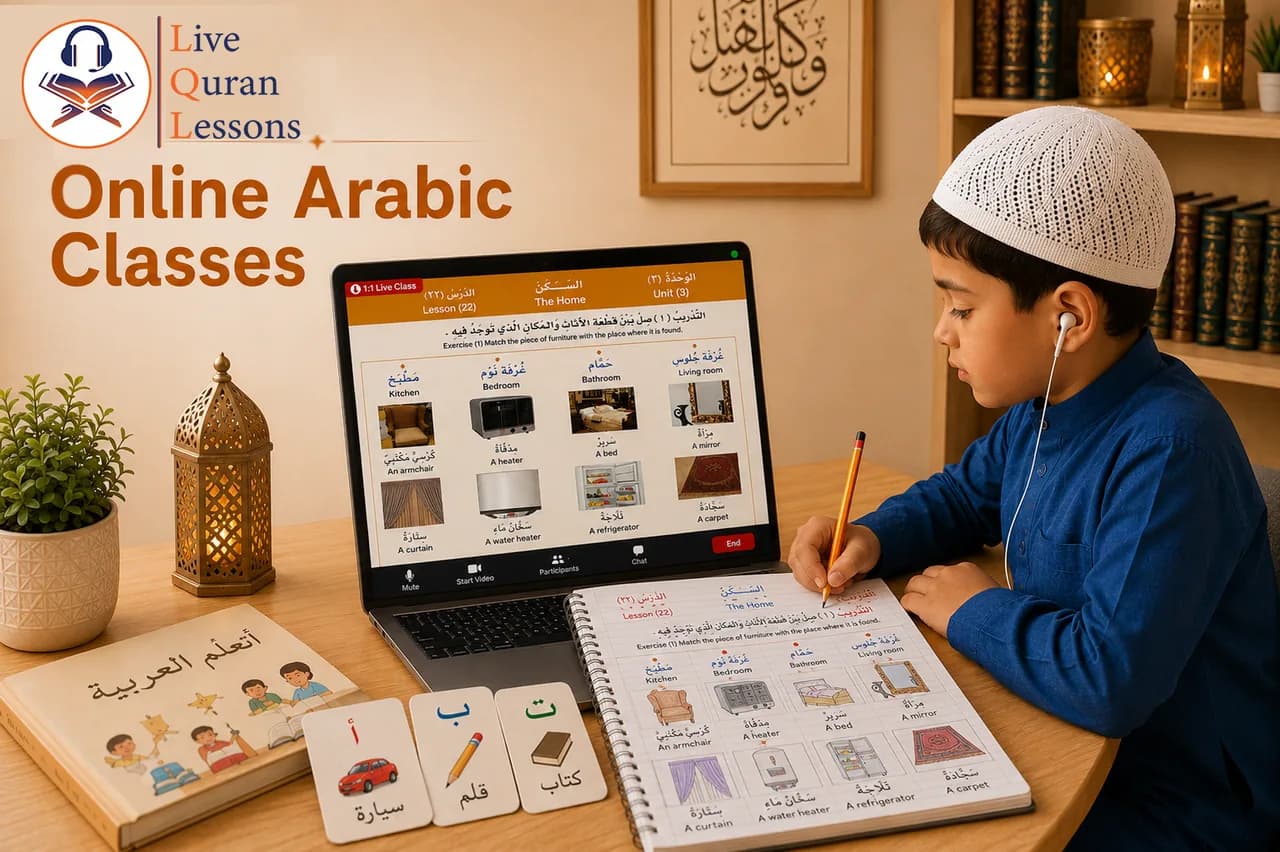
Your child learns the Arabic alphabet, then reads Quranic Arabic with correct pronunciation. Our online Arabic classes for kids are 1-to-1 with a qualified teacher, live on video, 30 minutes each.
Our online Arabic classes for kids teach a child to read the Arabic of the Quran. This is Quranic Arabic, the language of the book itself, and the teacher matches every part of it to your child's level. The work has 3 parts.
Conversational Arabic, the kind used to order food or ask the way, is a different subject. We do not teach it. Everything in this course points at one skill: opening the Quran, reciting a line correctly, and knowing the translation of its common words.
Children, from a complete beginner who has never seen the alphabet to a child who already recites the Quran.
The Arabic alphabet is a set of 28 letters, and every word of the Quran is written with them. Arabic is read from right to left. A letter changes shape depending on its position in a word, so your child learns every letter separately, in all of its forms.
Several of the sounds do not exist in English. Your child hears the pronunciation of each one from the teacher, repeats it, and is corrected on the spot.
A line begins at the right edge of the page. A child who already reads English learns to start every line from the opposite side.
An individual letter can look different once it is joined to its neighbors. The shape depends on the position of the letter: at the beginning of a word, inside it, or at the end.
Short vowels are small marks written above or below a letter, and the Quran prints every one of them. A child who knows the alphabet and the vowel marks can recite a line of the Quran from the page. That is the point the alphabet leads to, and the reason the letters come first.
It depends on what your child can already read. You tell us on WhatsApp whether your child is a complete beginner or has learned before.
The Noorani Qaida is the book for the alphabet. This course carries on past the Qaida, into the words of the Quran and their translation. There is no fixed course length. Where your child starts, and how many days a week they attend, decide the pace. Book the free trial from this page.
A class is your child, the teacher and the book on screen. No other student is in it, and there is no recording.
Your child's teacher holds a qualification from a recognized Islamic institution. The academy has both male and female teachers.
Arabic is not our teachers' first language. Their training is in Quranic Arabic, the same Arabic your child is learning to read. They give every explanation in the language your child follows more easily.
Nobody swaps your child's teacher without asking you first.
From a note the teacher writes after every class, and from watching whenever you like.
The note says what was covered and what to practise, in plain English, with a link to the exact page of the book. It comes to you in your family WhatsApp group. You may also watch any lesson yourself, from beginning to end.
The same group is where you ask for a change, and we try to settle it before the next class.
Ask in the group, and a different teacher is arranged. The new teacher is told exactly where your child has reached.
No contract and no minimum term. Fees are paid a month at a time, so you stop by telling us.
2, 3, 4 or 5, each class 30 minutes and 1-to-1, and the fee is set by the days a week.
A steady start, with time between classes to practise the page in the teacher's note.
$39 a month
Sign up for 2 days a week, 8 lessons a monthOften enough that new letters and words are still fresh at the next class.
More Arabic with the teacher each week, and shorter gaps between classes.
The most classes a week, so the most reading practice in a month.
Put your WhatsApp number in the registration form on this page, and we take it from there.
The form asks for 2 things: your country and your WhatsApp number.
Within 24 hours, and in practice within hours. We ask your child's name, what they can already read, and the days and time that suit your family.
Every one is 30 minutes, and the first can begin within an hour or two of your reply.
No credit card at signup. If you go ahead, regular classes begin and the monthly fee starts.
Why not speaking Arabic is not a barrier.
What a parent can do without Arabic.
The script comes before the language.
Up to 3 free classes, 1-to-1, and no credit card at signup.
Watch families and students talk about their own experience.
Hear it from your own child next. Up to 3 free classes, and no card at signup.
Book a Free Trial ClassSee why families choose our 1-to-1 online Quran classes for their children.
Try a free 1-to-1 class first. See how your child does with the teacher, then choose.
Book Up to 3 Free Trial ClassesNo credit card required · No obligation · Review excerpts shortened for clarity
Every course is taught one-to-one by a qualified tutor, and every one starts with up to 3 free trial classes.
The questions parents ask us most, answered.
Reading Quranic Arabic, with vocabulary and pronunciation matched to your child's level. The course does not teach conversational Arabic.
Once your child can sit for half an hour and repeat a sound back. The trial class will show you whether they are ready.
Our classes are for children. If you are an adult who wants to learn, ask us when you book.
Yes. 30 minutes is the standard length, and 45-minute and 1-hour sessions are also available. Ask when you book.
By card through Stripe, or by bank transfer through Wise. If neither works where you live, email us and we will arrange another way.
Your child keeps the same qualified teacher every week, at the same time. Every class is one-to-one. After each class the teacher writes a note: what was covered and what to practise.
Live, always. Every class is a live lesson on video with your child's teacher. We never send recordings in place of live lessons.
Beginners start with the Noorani Qaida. From there it is Quran recitation with Tajweed, and after that Hifz, translation or Tafseer, depending on what a family wants. Alongside the Quran your child learns Islamic Studies. Families on 5 days a week keep Friday as Islamic Day, which revises that week's Islamic Studies and adds one new lesson.
Yes, and it is checked before anyone teaches a child. Every teacher holds a qualification from a recognized Islamic institution, and several hold professional degrees as well. Nobody is given a student on an application alone. There is an interview, a document check, training, and a live demo class we sit in on. The academy page sets out each stage.
The teacher leads every class, and you can watch too. Every lesson runs on one link that never changes, and you can join any class without telling us first.
Send us your WhatsApp number on the form, or message us on WhatsApp. We ask for the times that suit you. We then place your child with a teacher who is free at that time. We reply on WhatsApp within 24 hours, and usually within hours.
Yes. Take up to 3 free trial classes first. Use them to check the teacher, the timing, and how your child responds before paying anything.
Yes. You are welcome to watch any lesson, without asking first.
There is no contract and no minimum term. Fees are monthly, and you pay for the month ahead. If you want to stop, tell us and we will stop. If you need a break instead, any unused balance carries to the next month. Before your regular classes begin, you can withdraw and get a full refund.
Through a WhatsApp group we open for your family after the trial classes. It has you and our academy team in it. Use it to move a class, ask for a different teacher, or raise anything at all. We try to settle it before the next class.
Arranging your trial class is the only thing we use it for, and we never pass it on to anybody. Once classes start it is the number in your family WhatsApp group.
You are welcome to watch any lesson yourself, without asking first, and a supervisor is listening in on every class. No teacher is given a student until we have checked their certificates and references. We then train them in how we teach, and sit in on a live demo class before they start.
Live Quran Lessons charges monthly, per child, by the days a week your child attends. 2 days a week is $39, 3 days $49, 4 days $59, and 5 days $65. Each lesson is 30 minutes, 1-to-1.